White Paper
The hidden cost of non-compliance
At first sight, non-compliance costs a fine. In reality, like an iceberg, most of the cost is hidden below the surface. We estimate the full cost of a non-compliance event at around 3% of annual revenue — and compare it with the cost of a purpose-built compliance platform.
What is the cost of non-compliance?
Food Contact Material (FCM) regulations generally do not set EU-wide fines and leave this to the member states. In general, the amount of the fine depends on the severity of the breach and other factors. Fixed fines range from a few thousand EUR to several hundred thousand EUR. Some countries set caps, such as France, at 5% to 10% of annual revenue. Some EU regulations set fines for non-compliance as a percentage of revenue (EUDR – min 4% of annual revenue).
A non-compliance event is not necessarily followed by a fine, but it can trigger consequential events that incur direct and indirect costs or loss of revenue. These consequences include:
Recalls: If the non-compliance is so severe that an FCM can no longer be placed on the market, it has to be recalled. Such an event disrupts your operations, generates extra costs and prevents you from generating revenue. Depending on the scale, the cost can run into millions. The cost of recall can be as high as ~1% of the annual revenue, as it was in the case of a Greenyard incident.
Productivity loss: In a crisis, employees have to act outside their comfort zone and do things they have never done before, without established routines to rely on. Such situations reduce productivity. It is extremely difficult to measure this cost, especially as these figures are rarely disclosed by any organisation. We can approximate that it can be about the same as the cost of recall, ~1% of the annual revenue.
Negative impact on reputation and loss of revenue: If such an event becomes public, it can have a negative impact on stock price and market value. It happened with Kellogg’s when their market value dropped by 0.45% in a day after a recall was announced. However, the bigger damage is not to the stock price but to reputation, which can make the difference in a highly competitive market. The opportunities lost due to a damaged or weakened reputation can be significant. The recall, together with a competitive cereal market, contributed to a 1% drop in Kellogg’s full-year net sales.
These costs are difficult to estimate, as they vary by industry, company, scale, etc. Nevertheless, we can approximate the cost of each of these categories as 1% of the annual revenue.
The total cost of non-compliance is therefore 3% of the annual revenue plus the fine, if there is any.
What would the cost of compliance be?
Organisations put a lot of effort into compliance, so we can assume that when they release a non-compliant product, they do not do it on purpose. The expert team is already in place. What they might be missing is the right purpose-built tool: one that facilitates their work, rather than just another piece of software to struggle with. Such software costs from a few hundred to a few thousand EUR per month, depending on the scale, number of users and additional services.
The diagram below shows an illustrative cost evolution when a technological solution is implemented. The cost of the existing compliance team is not plotted as it occurs with or without the solution. Evaluating and implementing such a technological solution involves some initial cost, followed by a ramp-up period as more users are onboarded. After that, the cost becomes predictable. The potential cost of non-compliance decreases as the whole compliance scope is managed in the platform; however, it will never be zero.
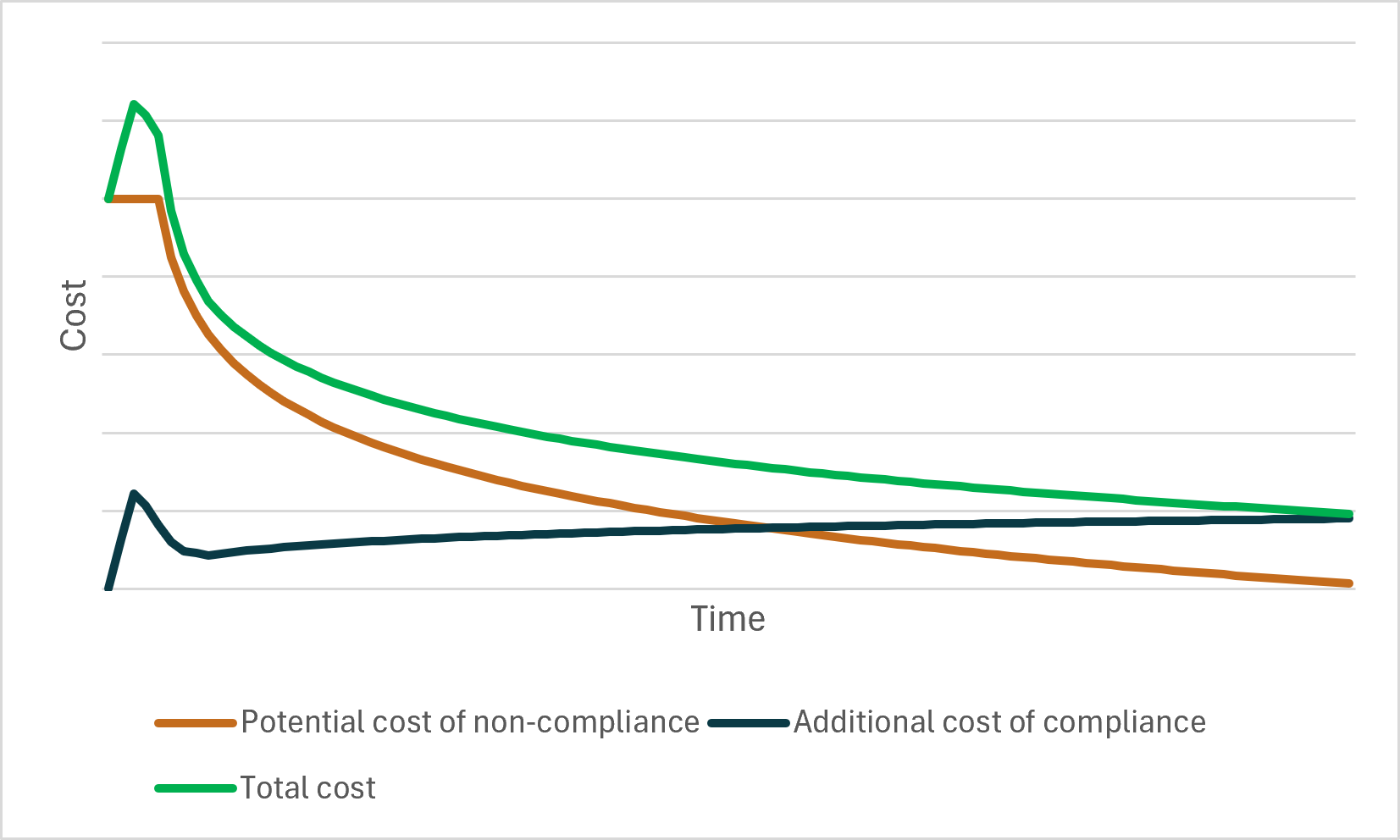
As Figure 1 shows, with a relatively small investment the risk of non-compliance and consequential financial damages can be reduced significantly. For a company with EUR 50M annual revenue, a serious incident could cost around EUR 1.5M (3%), while a compliance platform typically costs EUR 10,000–50,000 a year.