White Paper
Digital Product Passport: Ready for Traceable, Transparent Products
The EU's Digital Product Passport (DPP) requires products to carry machine-readable data on their identity, composition, footprint and compliance. Set by the Ecodesign for Sustainable Products Regulation, it starts with batteries in 2027. Similar schemes are emerging worldwide. This paper introduces the DPP and its global context. It also shows how CertCare's data structure was built for DPP compatibility.
What the EU Digital Product Passport is
The Digital Product Passport (DPP) is a structured, machine-readable data record that travels with a product across its whole life. It is reached through a data carrier on the product, such as a QR code, and holds the information needed to use, repair, reuse and recycle it responsibly.
The legal basis is the Ecodesign for Sustainable Products Regulation (EU) 2024/1781 (ESPR), in force since July 2024. Product-specific delegated acts will set exactly which data each product group must carry. The first mandatory passport is the battery passport under the Batteries Regulation (EU) 2023/1542, due from February 2027 for EV, industrial and light-transport batteries. Textiles, steel, aluminium, furniture, tyres and electronics follow in the ESPR working plan.
For companies, the DPP turns compliance data from scattered PDFs and supplier emails into verifiable, shared product data: unique identifiers, material composition, substances of concern, carbon footprint, conformity documents and end-of-life instructions, with tiered access for consumers, recyclers and market surveillance authorities.
The DPP at a glance
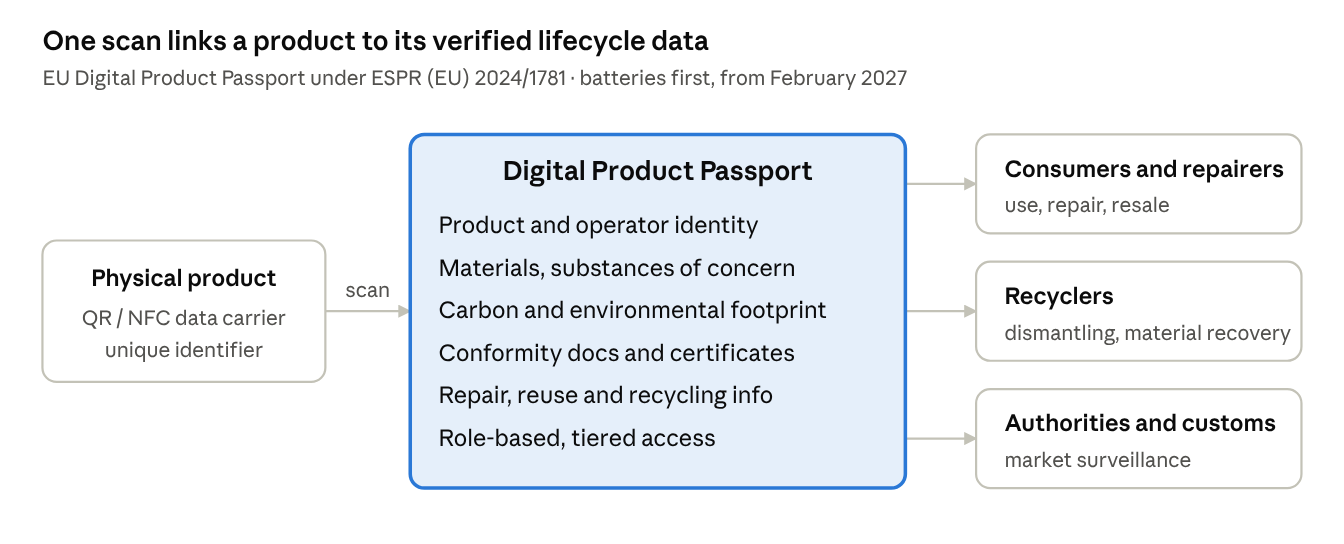
A single identifier on the product opens one passport, and each user group sees the data it is entitled to.
A global movement, not only a European one
The EU is first to legislate at scale, but other regions are moving towards the same idea of verifiable product data:
United Nations: UNECE's UN Transparency Protocol defines an open DPP data model, and UNECE and ISO have launched a joint DPP standards initiative.
India: draft Battery Pack Aadhaar guidelines propose a unique ID and lifecycle record for every EV battery.
Asia and North America: China is piloting product traceability and passport schemes, Japan's Ouranos Ecosystem links battery and supply-chain data, and the US already mandates serialised, interoperable tracing of prescription medicines under DSCSA (overview).
The common direction is clear: unique identifiers, structured data and trusted exchange across borders.
CertCare: built DPP-ready from the start
CertCare's data structure was designed to be compatible with DPP requirements, so customers can prepare today without rebuilding their data later.
Product-centric model: every product, variant and component has a unique identifier that can be linked to a data carrier.
Certificates and conformity as structured data: declarations, test reports and certificates are linked to the products they cover, with validity dates and version history.
Supply-chain inputs: supplier declarations on materials and substances are captured once and reused across products.
Role-based access and export: data can be shared at the right level with customers, recyclers and authorities, in machine-readable formats aligned with emerging DPP standards.
As delegated acts for each product group are published, CertCare maps the new required fields onto this existing structure, keeping customers ready for the EU passport and for similar schemes worldwide.